
You saw the recipe on Instagram three weeks ago. You know it existed. You remember the pasta, the herby green sauce, the person who posted it. What you don’t remember is where it went — which app, which folder, which day you saved it in a rush before the reel disappeared from your feed.
This happens constantly. A book recommendation from a friend. A product a coworker mentioned in Slack. An idea you had walking the dog. A screenshot of a quote you meant to revisit. None of it is lost, exactly — it’s just buried somewhere you’ll never think to look, in an app that only finds things if you remember the exact words you used to save them.
Call it digital amnesia: you know something exists, but your tools can’t help you find it, because they were never built to think the way memory actually works.
That’s the specific problem Recall9 (recall9.com) is built to solve — and it’s worth understanding both what it is and why its approach is different from the usual note-taking or bookmarking app.
What Recall9 Actually Is
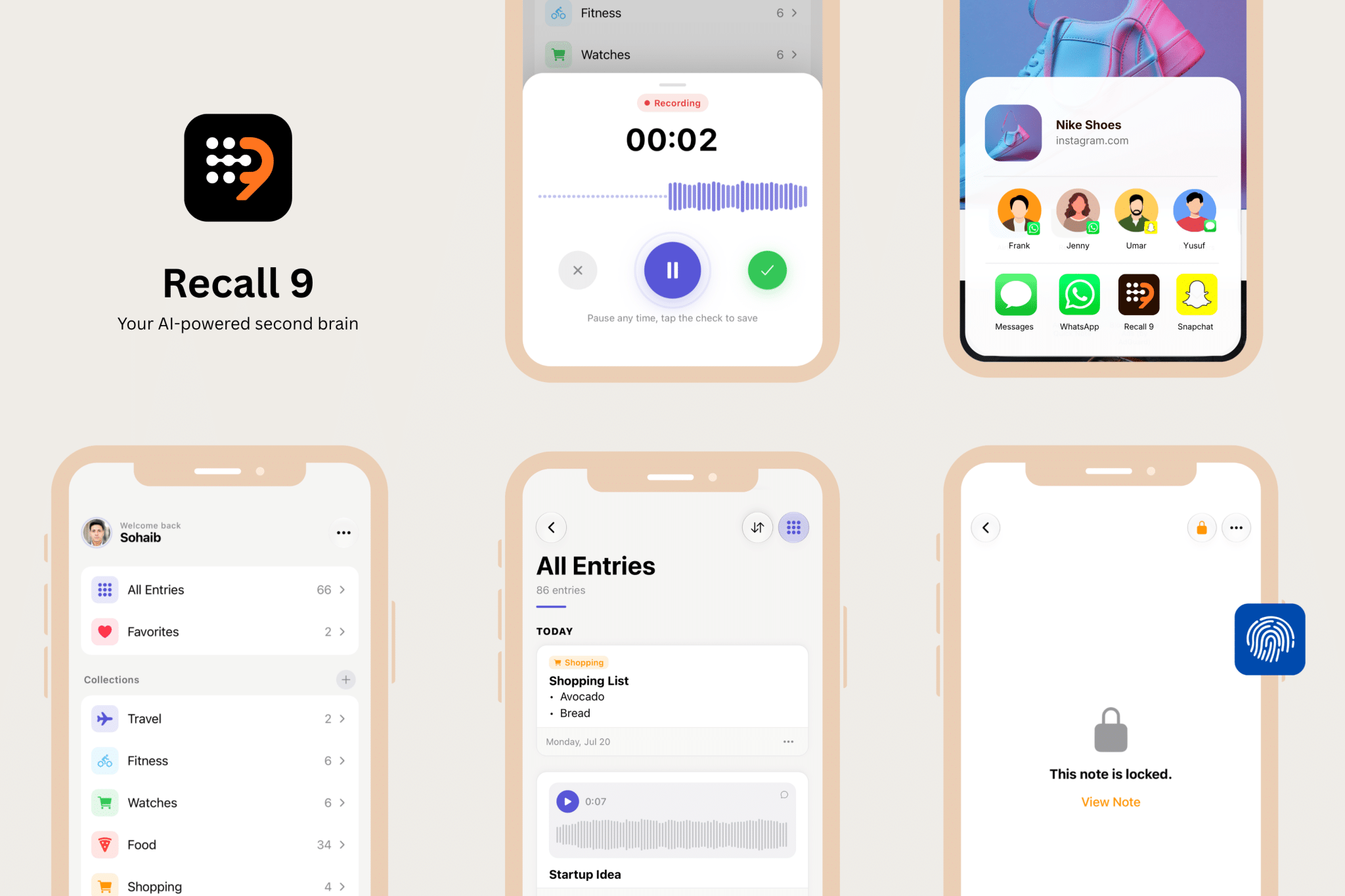
Recall9 describes itself as an AI second brain — but unlike a lot of tools wearing that label, it isn’t a productivity system you have to build and maintain. It’s closer to a personal memory app: a place where anything you capture — links, photos, voice notes, screenshots, social media posts — gets stored, and an AI layer handles bringing it back when you need it.
That distinction matters. Tools like Notion or Obsidian are genuinely powerful knowledge management apps, but they ask you to be the architect: you design the folders, apply the tags, build the links between notes. If you stop maintaining the system, it stops working. Recall9 skips that step entirely. There’s no filing, no tagging, no categorizing. You capture something in a tap or a sentence, and that’s the whole job on your end.
How the AI Recall Actually Works
The core mechanic is semantic search — search by meaning instead of exact keywords. Most apps make you remember the precise title, filename, or phrase you used months ago. Recall9 instead lets you describe a memory the way you’d describe it to a friend: “that pasta recipe from Instagram,” “the book Sarah told me about,” “the tax app someone recommended.” The AI matches intent, not exact text, and surfaces the right result.
That’s a meaningful difference from a plain notes app or a folder-based photo library. A digital memory assistant that only responds to exact keywords isn’t really solving the amnesia problem — it’s just moving the burden of memory from your brain to your search bar. Recall9’s bet is that recall should work the way your memory actually works: fuzzy, associative, and forgiving of imprecise wording.
Built for Capture, Not Curation
Where a lot of AI notes apps assume you’re sitting down to write something, Recall9 is built for the opposite moment — the fast, unstructured capture that happens mid-scroll, mid-walk, or mid-conversation:
- 1-tap save, from Instagram, TikTok, X, Chrome, or anywhere else you’re already browsing.
- Voice-to-memory, for the idea you have hands-free — driving, walking, cooking — that gets transcribed and made searchable automatically.
- Photos and screenshots, saved as-is, without needing to rename or file them anywhere.
None of it requires deciding where something “belongs” first. That’s the actual relief for most people: not a better filing system, but no filing system at all.
Local-First, So Recall Doesn’t Depend on a Server
One detail that separates Recall9 from most cloud-based AI-powered knowledge base tools: it’s local-first, and both capture and recall work without an internet connection. A lot of competitors in the second-brain space are fully cloud-dependent, which is fine until you’re somewhere with no signal and need to pull up the one thing you saved for exactly that moment.
Memories That Behave Like Memories
Recall9’s other differentiator is more conceptual: notes that go untouched for long enough start to fade, the way real memories do, quietly signaling what’s worth revisiting versus what’s safe to let go. It’s a small design choice, but it’s a deliberate departure from the typical second brain app, where everything you’ve ever saved sits in an undifferentiated pile forever, equally “important” whether you looked at it yesterday or three years ago.
Who This Is Actually For
This isn’t just a brain dump app for hoarding links. It tends to click hardest for:
- People drowning in information overload from social media — the “I’ll come back to this” pile that never gets revisited.
- Students and researchers who need an external brain app for scattered notes, quotes, and reading material.
- Entrepreneurs and freelancers juggling ideas, client details, and inspiration across a dozen different apps.
- Anyone who’s tried a traditional personal knowledge management system, found it exhausting to maintain, and gave up within a week.
The Bottom Line
Recall9 isn’t trying to be a more powerful Notion or a prettier Obsidian. It’s built around a narrower, more honest premise: most people don’t want to organize their thoughts — they just want to get them out of their head and trust they’ll be able to find them again. Capture takes a second. Recall works the way memory actually works, in plain language, whether or not you’re online.
If digital amnesia — the screenshots you’ll never find, the links that vanish into a scroll history, the recommendation you know you saved somewhere — sounds familiar, Recall9 is worth a look at recall9.com.