
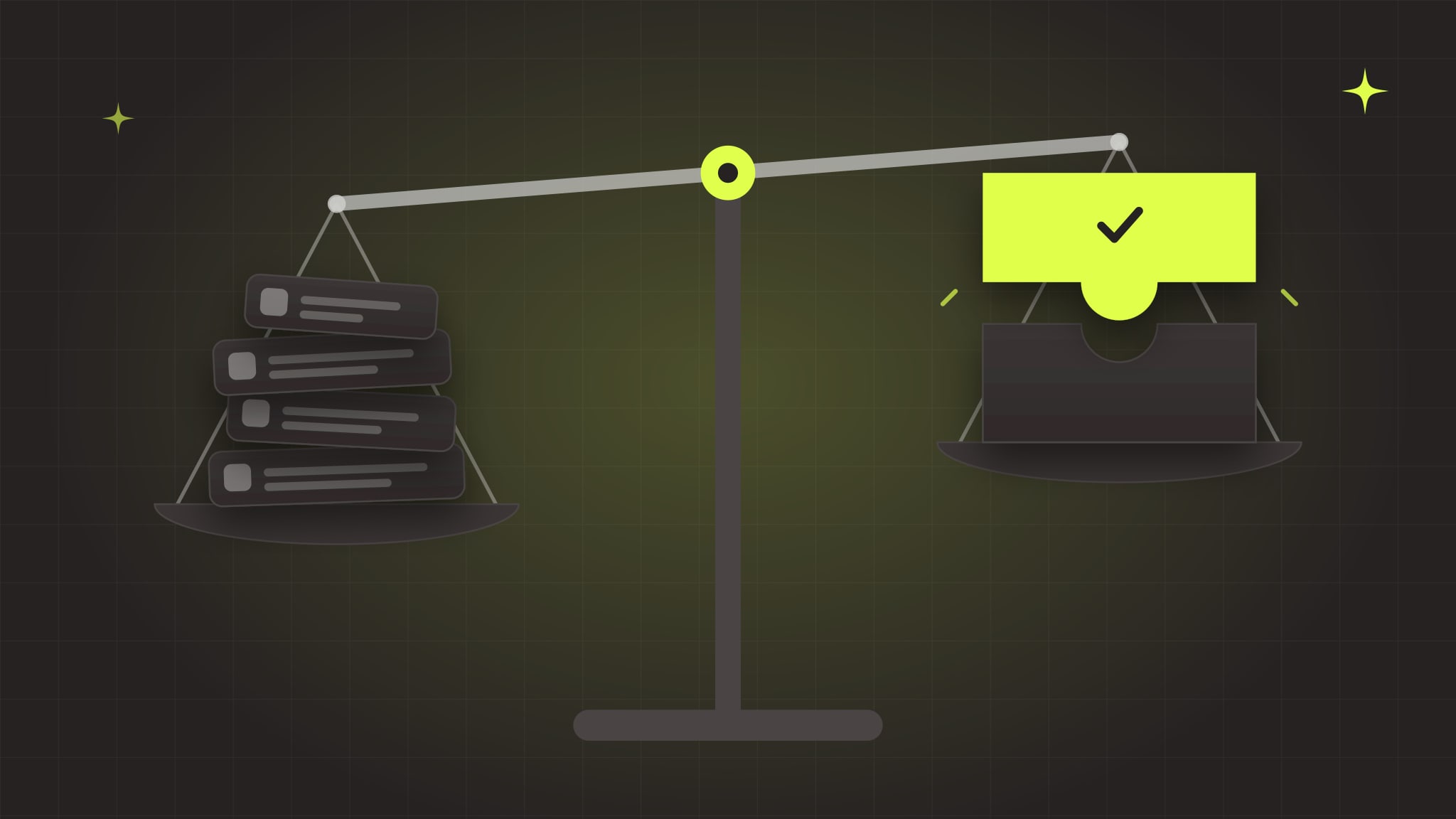
Buy off-the-shelf software for the work every business does the same way, like accounting, payroll, email and basic CRM. Build custom software for the work that makes your business different, or that no tool handles without hours of workarounds every week. Most businesses end up with a mix: proven off-the-shelf tools at the core, with custom pieces that connect them and fill the gaps. The right answer depends less on budget than on how standard your process is and what the workarounds are costing you now.
We've built custom software for businesses in Kansas City and across the country since 2017, and part of that job is telling people when they don't need it. This is the framework we use to decide.
The quick test: seven questions
Answer these honestly about the process you're trying to improve.
| Question | Points toward off-the-shelf | Points toward custom |
|---|---|---|
| Do most businesses in your industry do this the same way? | Yes | No, our way is part of why customers pick us |
| Is there a well-reviewed tool that does 90% of what you need? | Yes | The best tool covers maybe 60% |
| How much manual work happens around the tool today? | Very little | Hours a week of re-typing, exports and spreadsheets |
| How many tools does this process touch? | One or two | Four or more that don't talk to each other |
| Will the process change much in the next few years? | It's stable and standard | It changes as we grow, or it's the product itself |
| Do you need to own the data and the logic? | Not really | Yes, for compliance, resale or competitive reasons |
| How many people use it? | A handful | Dozens or more, with per-seat pricing climbing |
If most of your answers land in the left column, buy. If most land on the right, custom software (or a custom layer on top of what you have) is worth a serious look.
When off-the-shelf wins
Off-the-shelf software (also called SaaS, or "software as a service") is the right call more often than developers like to admit:
- The process is standard. Accounting, payroll, email, calendars, e-signatures and help desks work about the same everywhere. Tools like QuickBooks or Microsoft 365 have had millions of users shaking out the bugs. You won't build something better.
- You need it next week. A subscription can be running today. Custom software takes weeks to months.
- Compliance is built in. Payroll tax tables, payment card security and many healthcare requirements are expensive to get right yourself. Paying a vendor to own that is usually smart.
- The tool's way is a reasonable way. If adapting your process to the software costs less than adapting the software to your process, adapt.
The catch is that off-the-shelf costs are easy to underestimate. Per-seat prices grow with your team, vendors raise prices and move features into higher tiers, and the hours your staff spend working around the tool's gaps never show up on the invoice.
When custom software pays off
Custom software makes sense when the work is specific enough that no product fits, or valuable enough that a better fit pays for itself:
- Your process is your advantage. If the way you schedule, quote, deliver or serve customers is why they choose you, forcing it into a generic tool sands off the edge.
- The workarounds have become a job. As an example, if five people each spend four hours a week re-typing orders between systems, that's over 1,000 hours a year. Software that removes that work pays for itself quickly.
- Nothing on the market does it. Some problems are specific to your industry, region or business model.
- The software is the product. If you're selling a platform, an app or a service delivered through software, you need to own it.
- You've outgrown the tool. Performance, limits, missing integrations or pricing that no longer makes sense at your size.
Some real examples from our work:
- Route planning for home health nurses. American River Healthcare sends nurses to patients' homes across the Sacramento region. We built a custom web application that plans optimized daily routes for each nurse, so they spend less time driving and more time with patients. Generic route planners don't understand visit windows, patient assignments and how a home health office actually schedules.
- A loyalty program built around airport parking. For Parking Company of America, we built a custom parker loyalty web app that rewards repeat customers, designed around how their parking operations work rather than a generic retail points system.
- When the software is the business. SeeInMe helps care organizations personalize care. We built both the marketing site and the care app that care teams sign in to every day. For a product company, owning the software isn't optional.
The middle path most businesses choose: keep the core, build around it
The choice is rarely all or nothing. Often the best answer keeps the off-the-shelf tools that work and builds custom pieces to connect them and fill the gaps:
- Integrations that move data between your CRM, accounting, scheduling and ecommerce tools automatically, through their APIs.
- A custom front end (a customer portal, an internal dashboard, a smarter intake form) on top of systems you already trust.
- A single source of truth that merges data from several tools into one reliable database.
- Automation that handles the routine steps between systems. Sometimes that's code; sometimes a tool like Make.com does the job for far less.
APA Medical is a good example. They wanted their customer-facing processes in one modern platform, but their medical billing platform held data and functionality they couldn't lose. Instead of replacing it, we built a platform that works with it and with HubSpot, so their customer service team works in one place. Similarly, for New Generations we built the forms and tools that collect information from the field and merged several data sources into one picture their team can act on.
The hybrid approach usually costs less than a full custom build, gets to value faster and leaves the hard, regulated parts (billing, payroll, payments) with vendors who specialize in them. If disconnected systems are your main pain, our post on the hidden costs of disconnected business systems goes deeper.
Compare the real cost, not just the price
Subscriptions look cheap and custom builds look expensive, because one is billed monthly and the other up front. Compare both over three to five years.
Off-the-shelf, count:
- Subscription price × number of users × years, with room for price increases
- Add-ons, higher tiers and integration tools you'll need to make it fit
- Staff hours spent on workarounds, duplicate entry and exports
- The cost of switching later, especially if your data is hard to get out
Custom, count:
- The initial build, ideally in phases
- Hosting, which for most business applications is modest
- Ongoing maintenance: security updates, bug fixes and small improvements (plan for this every year; software that isn't maintained becomes a liability)
- Your team's time during discovery and testing
What you get back: the hours saved, errors avoided, faster service, and sometimes revenue the old setup couldn't support. If the numbers only work in a best-case scenario, buy instead, or start with a smaller custom piece. For a sense of how project costs are scoped in this market, see our Kansas City website cost guide, which also covers custom web applications.
How to reduce the risks of going custom
Custom software has real risks: projects that run long, software only one developer understands, and systems nobody maintains after launch. You can avoid most of them:
- Own everything. The code, hosting, domain and accounts should be in your name, with access you control. Walking away should never mean starting over.
- Start with the smallest useful version. Build the piece that removes the most pain first, put it in front of real users, then expand. You learn more from two weeks of real use than two months of planning.
- Insist on a written scope and milestones. You should see working software regularly, not just at the end.
- Plan for maintenance from day one. Ask who handles security updates and fixes after launch, and what that costs. Our care plans exist for exactly this.
- Avoid single-person dependency. Documentation, standard technologies and a team (not one freelancer) mean the software outlives any one developer.
Our guide to choosing a web development company in Kansas City has a full list of questions to ask before you sign.
Does AI change the decision?
Somewhat. AI coding tools make building faster, which lowers the cost of custom software, and AI features (reading documents, drafting replies, routing requests) are increasingly worth building into your own tools. But faster to build isn't the same as ready for production. Apps generated quickly with AI tools often ship with security gaps like missing database access rules. If you've already built something with an AI tool and want to know if it's safe to run your business on, our app rescue service reviews it.
If you're weighing AI automation specifically, start with what a small business should automate first.
Custom software development in Kansas City
Prodjex is a web and software development company in Liberty, Missouri. Since 2017 we've delivered more than 616 projects, from business websites to web and mobile applications, integrations and custom platforms for healthcare, manufacturing, nonprofits and service businesses.
We'll tell you honestly whether you need custom software, a better-configured off-the-shelf tool, or a small custom piece connecting what you already have. You'll get a written, fixed or capped estimate, the code and accounts are always yours, and we stick around after launch.
Book a free call and tell us about the process that's slowing you down.